
The goal of sustainable agriculture is to meet society’s food and textile needs in the present without compromising the ability of future generations to meet their own needs. Practitioners of sustainable agriculture seek to integrate three main objectives into their work: a healthy environment, economic profitability, and social and economic equity. Every person involved in the food system—growers, food processors, distributors, retailers, consumers, and waste managers—can play a role in ensuring a sustainable agricultural system.
There are many practices commonly used by people working in sustainable agriculture and sustainable food systems. Growers may use methods to promote soil health, minimize water use, and lower pollution levels on the farm. Consumers and retailers concerned with sustainability can look for “values-based” foods that are grown using methods promoting farmworker wellbeing, that are environmentally friendly, or that strengthen the local economy. And researchers in sustainable agriculture often cross disciplinary lines with their work: combining biology, economics, engineering, chemistry, community development, and many others. However, sustainable agriculture is more than a collection of practices. It is also process of negotiation: a push and pull between the sometimes competing interests of an individual farmer or of people in a community as they work to solve complex problems about how we grow our food and fiber.
Background
 Agriculture has changed dramatically, especially since the end of World War II. Food and fiber productivity soared due to new technologies, mechanization, increased chemical use, specialization and government policies that favored maximizing production. These changes allowed fewer farmers with reduced labor demands to produce the majority of the food and fiber in the U.S.
Although these changes have had many positive effects and reduced many risks in farming, there have also been significant costs. Prominent among these are topsoil depletion, groundwater contamination, the decline of family farms, continued neglect of the living and working conditions for farm laborers, increasing costs of production, and the disintegration of economic and social conditions in rural communities.
A growing movement has emerged during the past two decades to question the role of the agricultural establishment in promoting practices that contribute to these social problems. Today this movement for sustainable agriculture is garnering increasing support and acceptance within mainstream agriculture. Not only does sustainable agriculture address many environmental and social concerns, but it offers innovative and economically viable opportunities for growers, laborers, consumers, policymakers and many others in the entire food system.
What is sustainable agriculture?
Sustainable agriculture integrates three main goals — environmental health, economic profitability, and social and economic equity.
A variety of philosophies, policies and practices have contributed to these goals. People in many different capacities, from farmers to consumers, have shared this vision and contributed to it.
Despite the diversity of people and perspectives, the following themes commonly weave through definitions of sustainable agriculture:
Sustainability rests on the principle that we must meet the needs of the present without compromising the ability of future generations to meet their own needs.
Therefore, stewardship of both natural and human resources is of prime importance. Stewardship of human resources includes consideration of social responsibilities such as working and living conditions of laborers, the needs of rural communities, and consumer health and safety both in the present and the future. Stewardship of land and natural resources involves maintaining or enhancing this vital resource base for the long term.
A systems perspective is essential to understanding sustainability.
The system is envisioned in its broadest sense, from the individual farm, to the local ecosystem, and to communities affected by this farming system both locally and globally. An emphasis on the system allows a larger and more thorough view of the consequences of farming practices on both human communities and the environment. A systems approach gives us the tools to explore the interconnections between farming and other aspects of our environment.

Everyone plays a role in creating a sustainable food system.
A systems approach also implies interdisciplinary efforts in research and education.
This requires not only the input of researchers from various disciplines, but also farmers, farmworkers, consumers, policymakers and others.
Making the transition to sustainable agriculture is a process.
For farmers, the transition to sustainable agriculture normally requires a series of small, realistic steps. Family economics and personal goals influence how fast or how far participants can go in the transition. It is important to realize that each small decision can make a difference and contribute to advancing the entire system further on the “sustainable agriculture continuum.” The key to moving forward is the will to take the next step.
Finally, it is important to point out that reaching toward the goal of sustainable agriculture is the responsibility of all participants in the system, including farmers, laborers, policymakers, researchers, retailers, and consumers. Each group has its own part to play, its own unique contribution to make to strengthen the sustainable agriculture community.
(source: http://asi.ucdavis.edu/programs/sarep/about/what-is-sustainable-agriculture)
Edible Landscapes
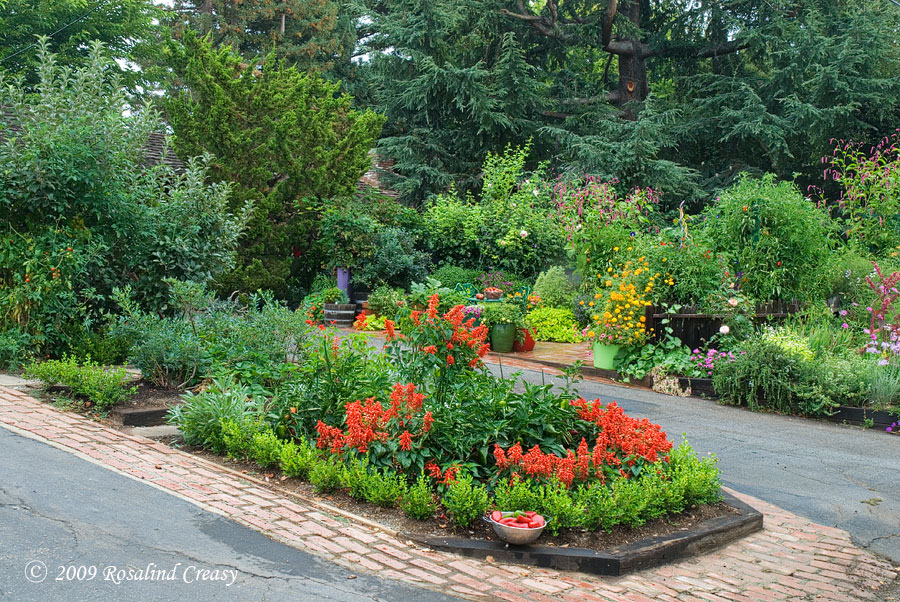
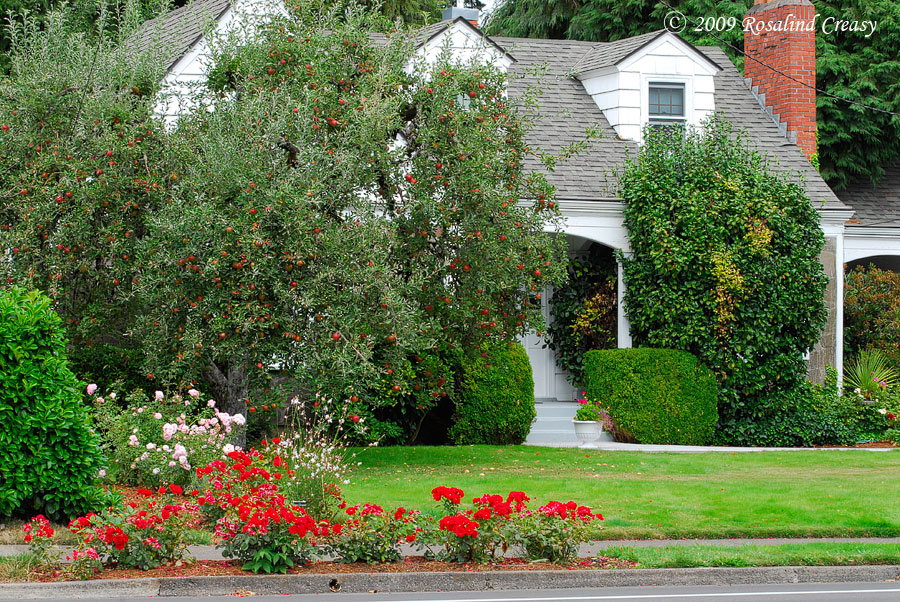
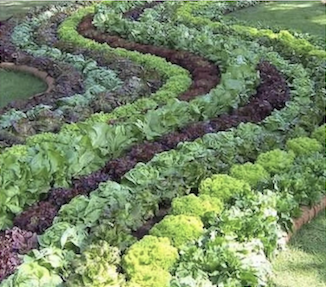 Edible landscaping is the practical integration of food plants within an ornamental or decorative setting. The same design principles as for ornamental landscapes are used, while substituting edible plants such as lettuces, blueberries, vegetables and fruit trees for some of the otherwise unproductive plant material. Using edibles in landscape design can enhance a garden by providing a unique ornamental component with additional health, aesthetic, and economic benefits. Edible landscaping is a mixture of beauty and utility. However, edible landscaping doesn’t have to be all edible. In fact, filling the yard with edibles would often produce too much food for most families, not to mention time and work. Instead, careful planning and the judicious use of fruits, herbs, and vegetables results in a yard that is flavorful, practical, visually pleasing. As a bonus, it’s a great topic for conversation!
Homeowners in all climates-with small or large yards-can benefit from a trellis of cherry tomatoes cascading over the entryway, a fragrant border of colorful and flavorful basils, or a prolific semi-dwarf apple tree or two. There are tasty and ornamental edible plants for just about any garden setting in any climate. Only the most shady areas and soggy soils are not suitable. The sunniest spots and the areas with the choicest soil are best reserved for most fruit trees and annual vegetables. On the other hand, there are culinary herbs suitable for rocky or poor soils, and a few perennial edibles for wet locations. Theoretically, any edible plant can be used in an ornamental landscape; but practically and aesthetically, some are better suited than others.
Combining Edibles and Ornamentals
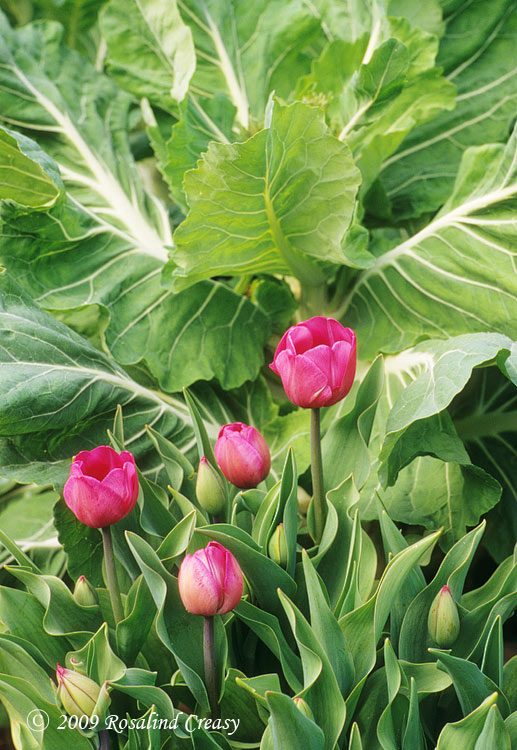
Edible plants can be combined in many creative ways-with other edibles, or with ornamentals. For instance: try a cool-season border of lettuces and spinach interplanted with dwarf nasturtiums. All types of pepper are striking when combined with dwarf marigolds or a background of tall red salvias. In shady areas, try a border of alpine strawberries and curly parsley under a hedge of currants. For your dwarf fruit trees try planting them in geometric beds surrounded with a border of culinary herbs; or plant them along the driveway instead of the usual privet or junipers.
Edible Landscaping Design Elements
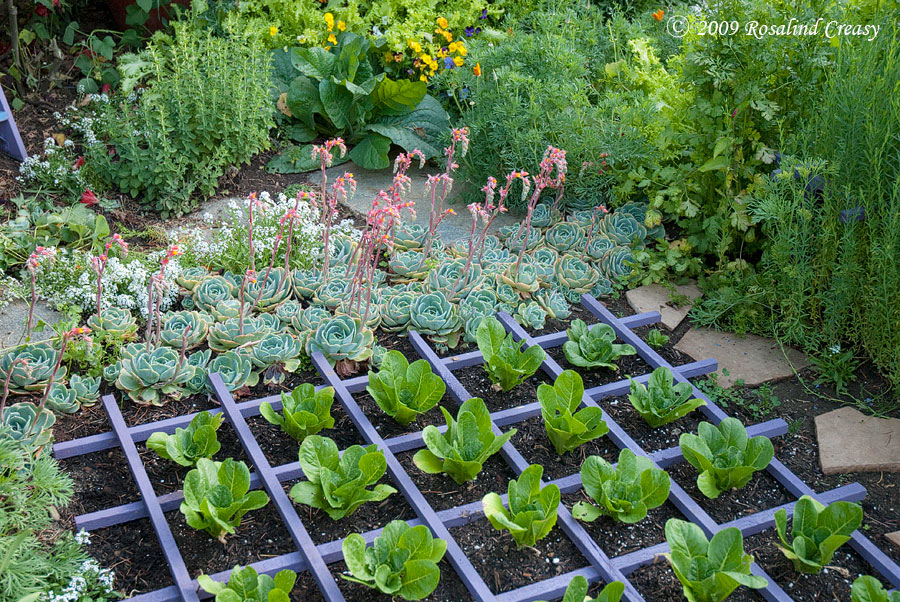
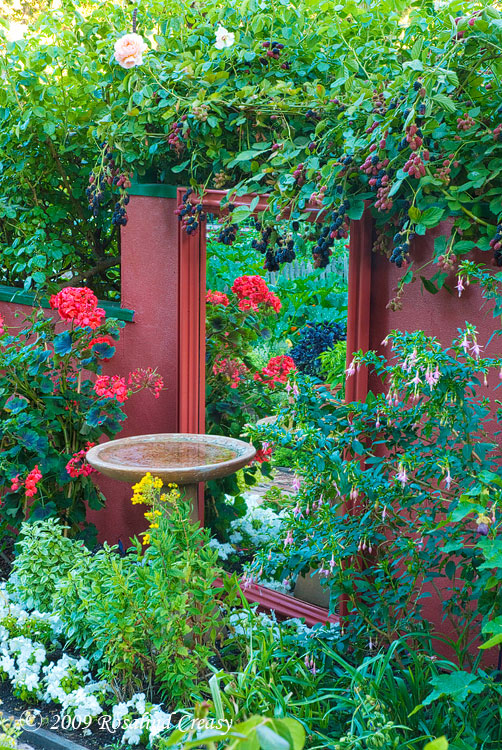 The most important design elements for an edible landscape are strong, firm lines and structure. With edible plants, the main goal is a diversity of food on your table and not just the look of your yard. However, in a purely aesthetic sense, adding edibles to your design provides a greater mixture of textures, forms, and colors than a typical ornamental landscape. In order to counterbalance this mix of plants, it helps to almost over-emphasize the line and structure of your landscaping elements. A design consideration with edibles is the seasonal nature of the color-flowers, fruit, and/or foliage-and occasional times of reduced drama due to transplanting, harvesting, and soil cultivation. During these times, the importance of strong lines, as defined by pathways, patios, planters, hedges, evergreens, and structures, becomes evident. Long curving beds or interplantings of colorful flowering plants-edible or not-also help tie the design together and provide accents to intrigue your eye. Edible landscaping is more than just planting edibles. Without the backbone of an integrated design, an edible landscape can become just another scraggly vegetable patch.
With any edible landscape, folks are advised to start small. Small and simple means you can easily maintain what you’ve started. Temper spring enthusiasm with the knowledge that many edible plants not only need maintenance (mulching, watering, weeding, feeding, and pruning), but also take effort in the form of harvesting and cooking- and preserving a large harvest. Choose dwarf fruit trees over standard-size trees and select fruit varieties that spread the harvest over many months.
Healthy Plants are Beautiful Plants
Good design is important, but if the plants are not healthy, the best of designs is for naught. The keys to healthy plants are choosing the correct plant for the right place and properly preparing the soil. Most edible plants need at least six hours of mid-day sun to produce well, and be healthy. With few exceptions, most edible plant varieties require soils with fast drainage. Soggy soil is the culprit for many failed edible gardens. Annual fruits and vegetables need soil filled with lots of organic matter and a source of nitrogen.
Expect trees and shrubs in your landscape design to take from three to five years to start to look mature. On the other hand, annual beds filled with herbs, vegetables, and flowers can give you a colorful and tasty impact starting the very first season.
Certainly, an edible landscape is one of the most rewarding yards one can have. You’ll be able to grow tasty treats that can’t be bought for love or money, often with enough to share with friends and neighbors. An edible landscape is the only form of gardening that truly nurtures all the senses.
(source: http://www.rosalindcreasy.com/edible-landscaping-basics/)